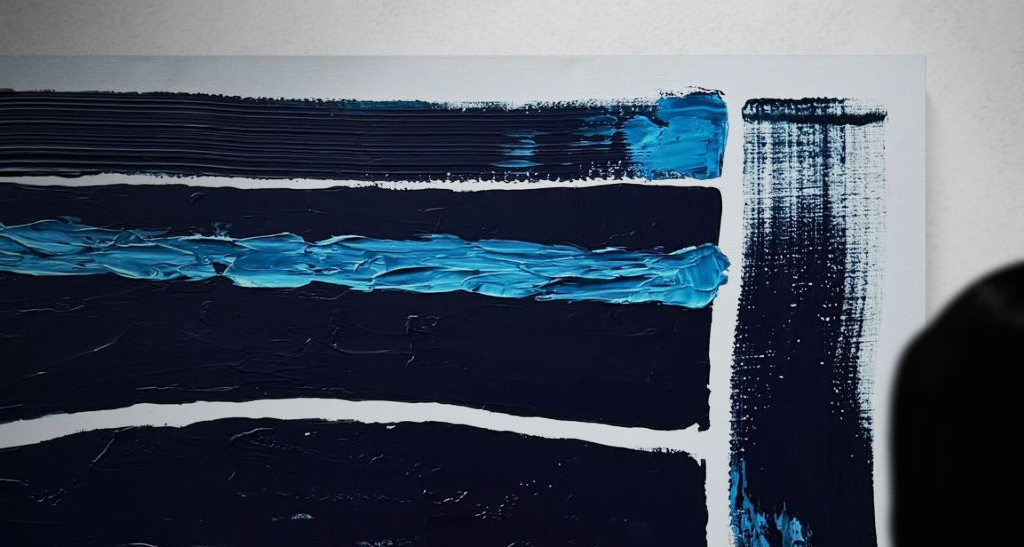
For a long time, varnishing was the last step. You finished a painting — let it cure, waited the requisite weeks, sometimes months — and then you applied a layer of varnish to unify the surface, to protect it, to give it the glossy or satin finish that made it look, as the art supply catalogues used to say, professional.
I stopped doing this. I want to explain why, because it is not a decision made carelessly, and it matters to how the work looks and lives in a space.
What varnish does to a surface
Varnish homogenises. Its purpose is to create a uniform sheen across a painting's surface, which means that the passages where the paint is thick and textured receive the same treatment as the passages where it is thin and smooth. The result is a surface that looks controlled, finished, resolved.
The problem — for me, not universally — is that this is precisely the quality I am not trying to create. My paintings are built from layered marks made at different times, with different pressures, in different moods. The texture is not incidental. It is the record of the painting's making. A gloss varnish covers that record. A matte varnish flattens it. Either way, something is lost.
An unvarnished surface keeps its breath. The paint is still itself — present, material, slightly vulnerable. That vulnerability is not a weakness. It is the honesty of the object.
The practical argument against varnish
There is also a material argument. Modern acrylic paints, when properly cured, are remarkably durable. They are flexible, resistant to UV, and more chemically stable than oil paintings of a similar age. The case for varnishing acrylics was stronger when the paints were less stable — fifty years ago. With current professional-grade materials, an unvarnished acrylic on a quality canvas, stored away from direct sunlight, will outlast the wall it hangs on.
I use professional-grade, artist-quality acrylics throughout my practice. The pigments are lightfast, the binders are stable. I do not use student-grade materials in finished work. The paintings I sell are built to last without varnish.
How to care for an unvarnished acrylic painting
The most common question I receive from collectors new to unvarnished work is: how do I clean it? The answer is simpler than most people expect.
Dust with a very soft, dry brush — a large, clean watercolour brush or a dedicated painting brush that has never seen solvent. Work lightly. Never rub. If there is a more stubborn mark — a fingerprint, a smudge — a barely damp cloth, wrung out completely, applied with no pressure and immediate drying, will handle almost everything. Never use cleaning products, window cleaner, or anything with alcohol. And keep the painting away from direct sunlight, which will fade any pigment over time, varnished or not.
If you have one of my paintings and a specific question about its care, please email me at info@fazy.studio. I would rather answer a careful question than have a painting cleaned incorrectly.
A note on matte and the question of presence
There is one more thing I want to say, which is less practical and more about looking. A matte surface does something different to light than a glossy one. Gloss reflects the room — you see yourself, the window, the lamp, imposed over the painting. Matte absorbs the room. The surface is quieter. The painting holds its ground.
I make work for specific spaces — domestic spaces, rooms with natural light, walls that are lived with rather than performed in front of. In those spaces, a matte surface is the right choice. It does not demand the room's attention. It repays it slowly, over time, in changing light.